
The Vote That Split the World on History - and Justice
Onyekachi Wambu
Onyekachi Wambu of AFFORD unpacks the implications of the United Nations’ resolution declaring the transatlantic slave trade as the “gravest crime against humanity”.
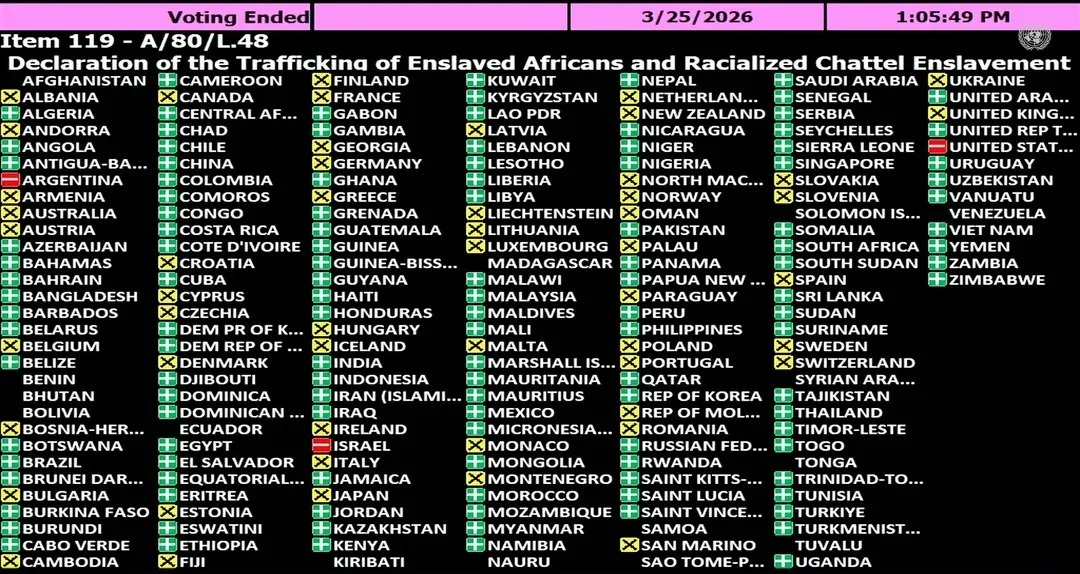
On 25 March 2026, the United Nations General Assembly did something both historic and overdue: it declared the transatlantic slave trade the “gravest crime against humanity.” The chamber erupted in applause. Yet the vote - 123 in favour, three against, and 52 abstentions - revealed a world still deeply divided not over history itself, but over what justice for that history should mean.
At the centre of the moment stood John Dramani Mahama, speaking for the African Group. His framing was not just moral but forward-looking: truth, healing, and reparatory justice. The resolution named the slave trade for what it was - a system of mass extraction, dehumanisation, and global economic engineering whose effects still structure inequality today. It also made a crucial leap: acknowledging reparations not as rhetoric, but as a “concrete step towards remedy.” It also made reparations an issue of diplomacy.
Importantly, this agenda is not abstract. The APPG for Afrikan Reparations and civil society organisations such as AFFORD and Stop the Maangamizi: We Charge Genocide/Ecocide Campaign have been advancing practical pathways to reparatory justice for years - most notably through campaigns for the restitution of looted African artefacts, the return of ancestral remains held in European institutions and All-Party Parliamentary Commission For Truth & Reparatory Justice. These efforts recognise that reparations are not only financial; they are cultural, spiritual, and epistemic. Returning what was taken - whether human remains or sacred objects -is part of restoring dignity and repairing historical rupture.
The opposition from the United States, Argentina, and Israel was not a denial of slavery’s horror, but a rejection of its legal and financial implications. Washington’s position was explicit: there is no legal obligation to compensate for acts that were not illegal under international law at the time. Beneath that argument lies a broader concern - opening the door to reparations could trigger an unbounded cascade of historical claims, from colonialism to indigenous dispossession, with enormous fiscal and political consequences.
For countries like Argentina and Israel, the calculus is similarly strategic. Both are navigating complex domestic and geopolitical realities, where endorsing reparations frameworks - especially those tied to historical accountability - could create precedents they are unwilling to accept. In essence, their “no” votes were less about the past and more about limiting future liability.
Europe, including the United Kingdom, chose abstention - a posture that speaks volumes. It reflects a tension between moral acknowledgement and political caution. European states, many of which built wealth through colonial systems, increasingly recognise the historical record. But endorsing reparations risks domestic backlash, legal exposure, and fiscal commitments that governments are reluctant to embrace. Abstention, then, becomes a diplomatic middle ground: neither denial nor acceptance.
Nowhere is that backlash more visible than in Britain’s own political discourse. Nigel Farage and Reform UK have proposed visa bans on countries pursuing reparations claims. This is not merely policy - it is a reframing of the debate as one of national defence against perceived external demands. The argument hinges on a familiar narrative: that Britain should be credited, not penalised, for abolishing slavery.
Similarly, Kemi Badenoch and the Conservative Party have rejected compensation outright, describing slavery as “a crime we helped eradicate.” This position reflects a broader ideological stance: that historical responsibility does not translate into present-day financial obligation. It is a line designed to resonate domestically - but one that sits uneasily with the global call for justice.
What this moment ultimately exposes is not disagreement over history, but over accountability. The applause in the General Assembly marked a symbolic consensus: slavery was a defining crime of humanity. But symbolism is the easy part. The harder question is what justice actually requires.
Reparatory justice is not only about money. It is about restructuring relationships: economic, political, and moral - and, as groups like the APPG for Afrikan Reparations have shown, restoring heritage, memory, and humanity itself. The vote, then, was not the end of a debate - it was the beginning of real diplomacy on the issue.